Does Early ArXiving Help Papers Get Accepted?
ArXiv.org has been a wonderful place for researchers to submit findings and catch up with the latest, but does submitting papers there (“early ArXiving”) increase the odds for them to be accepted later in a peer-reviewed venue?
(Drumroll please)
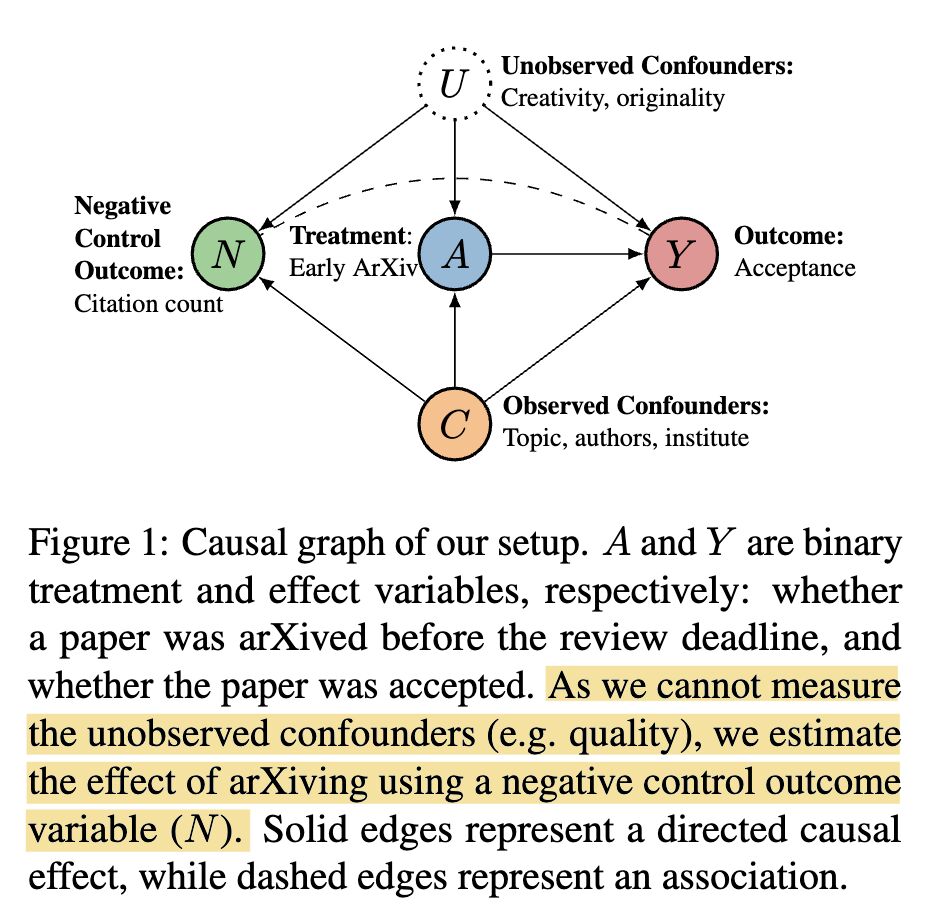
The authors answer this question in [1] by first laying out the causal graph where early ArXiving is the treatment (variable A) and paper acceptance in a conference is the effect (variable Y; screenshot 1). Two confounders exist — one unobserved that is the creativity and originality of a paper (intrinsic), while the other is observed that is the topic/authors/institute of a paper (extrinsic).
To cope with the unobserved confounder, they deploy a popular causal inference framework known as negative outcome control [2], where a variable called Negative Control Outcome (NCO) is added to correct the bias. NCO must share the same observed and unobserved confounders as the outcome variable while being not causally affected by the treatment. They use “citation counts after certain years of publishing” as the NCO.
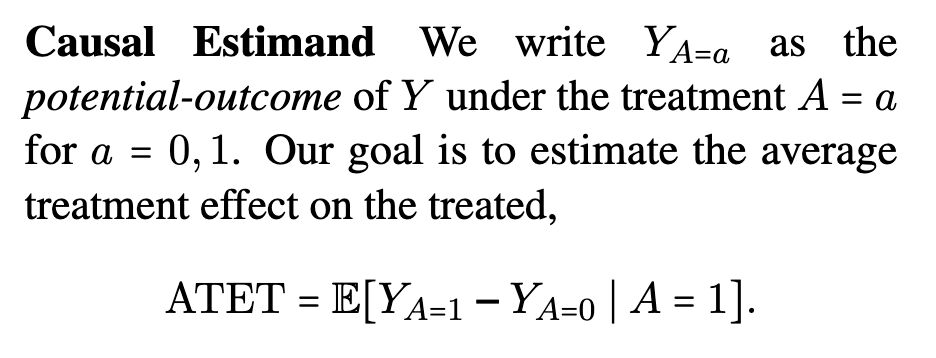
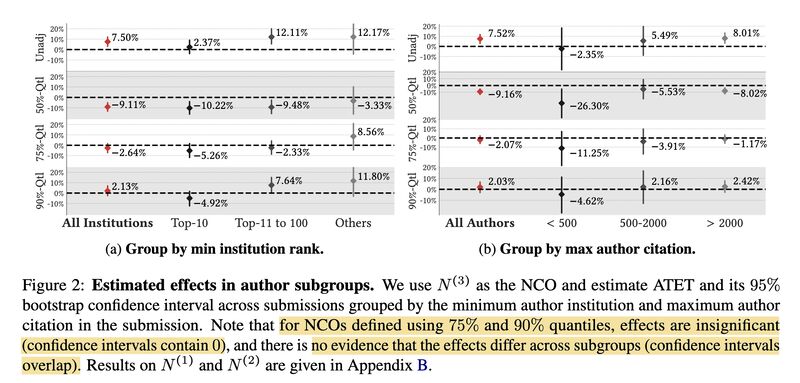
Numerically the effect of early ArXiving is defined by the causal estimand ATET (screenshot 2). The paper reports ATET is high (9.76%) before accounting for NOC. BUT after considering NCO, the effect is almost non-existent for authors with different citation counts or institution ranks (screenshot 3).
Conclusion: enjoy your guilt-free early ArXiving!
Originally posted on LinkedIn.
References
[1] Yanai Elazar, Jiayao Zhang, David Wadden, Bo Zhang, and Noah Smith. 2023. “Estimating the Causal Effect of Early ArXiving on Paper Acceptance.” http://arxiv.org/abs/2306.13891
[2] David Card and Alan B. Krueger. 1993. “Minimum Wages and Employment: A Case Study of the Fast Food Industry in New Jersey and Pennsylvania.” http://dx.doi.org/10.3386/w4509