GPTs are GPTs: Labor Market Impact of Large Language Models
OpenAI looks into how GPTs (Generative Pretrained Transformers) as GPTs (General-Purpose Technologies) may impact labor market. They conclud that 80% of the U.S. workforce could have at least 10% of their work tasks affected by the introduction of GPTs, while around 19% of workers may see at least 50% of their tasks impacted.
Details:
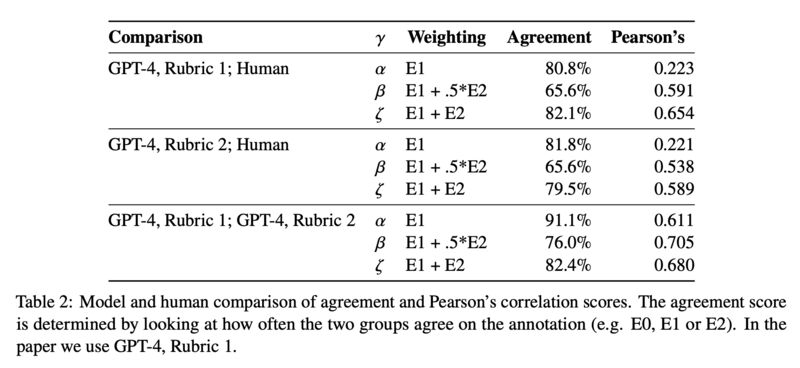
They define new rubric to measure impact: E0 (no exposure), E1 (direct exposure: LLMs alone can reduce task completion time by >=half), and E2 (LLM+ exposure: LLM with additional tools can reduce time by >=half).
They then deploy both humans and GPT4 to annotate over an occupation/task database (O*NET) and analyze. 3 scores are computed: alpha (lowerbound), beta, and zeta (upperbound). Agreements esp. on alpha is high (screenshot 1).
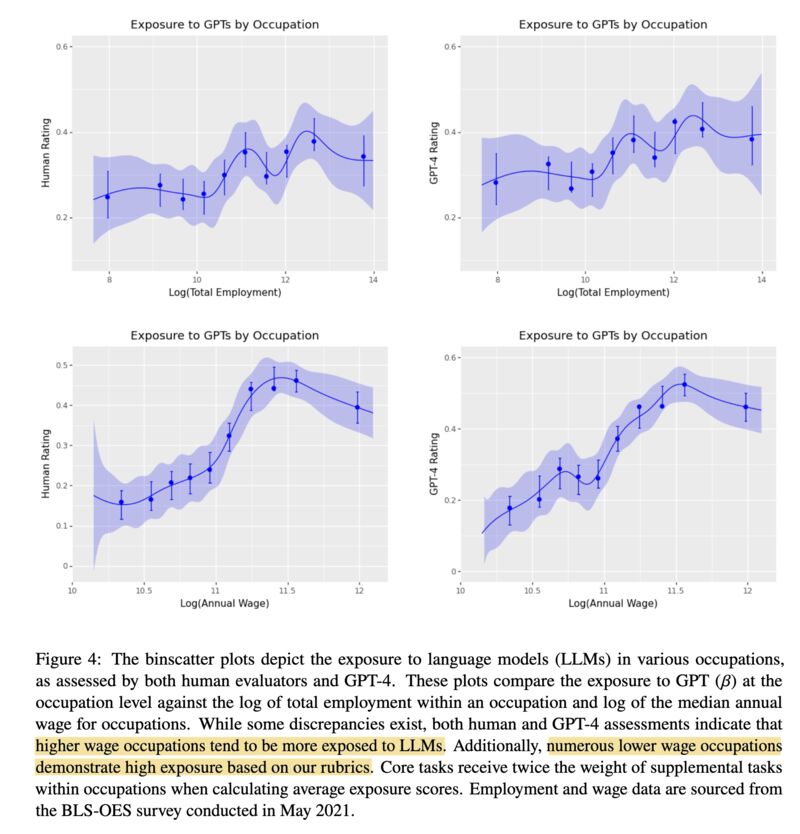
Higher wage occupations are impacted more (screenshot 2).
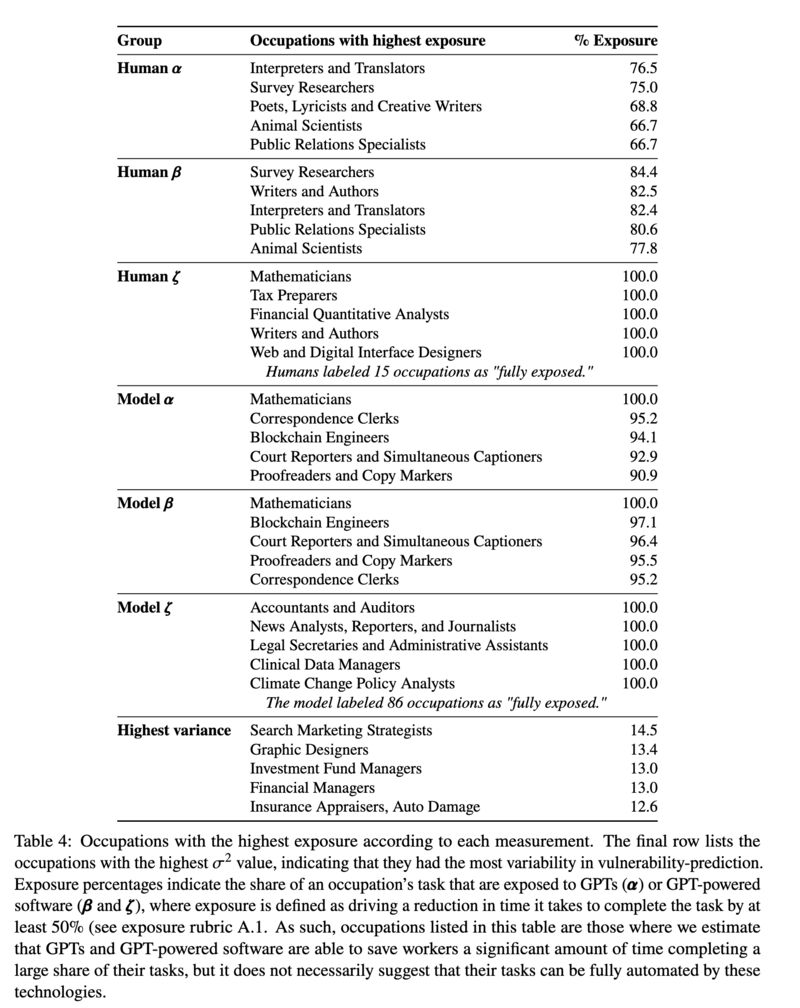
- Occupations involving languages and templated tasks are impacted more (screenshot 3). Curiously GPT4 thinks mathematicians are at the highest risk, while humans agrees only for E2 (partial impact).
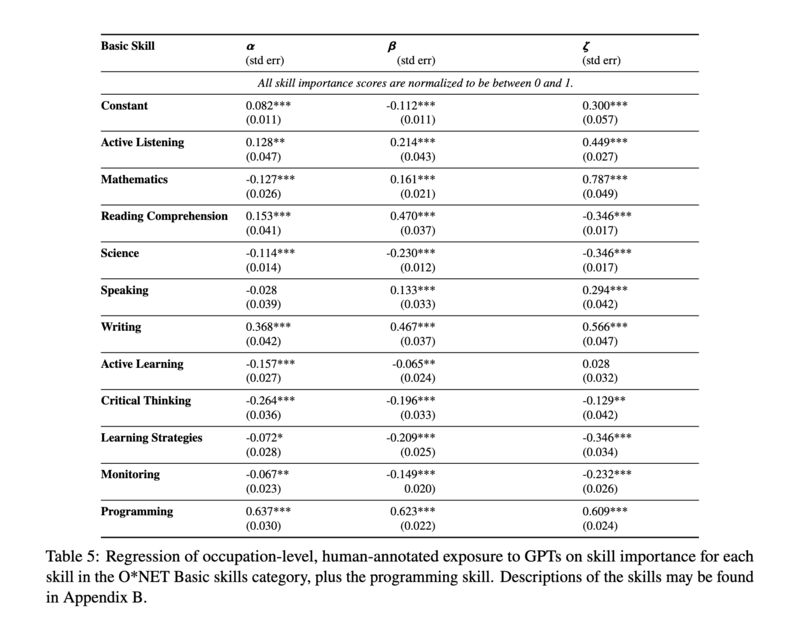
- Skill-wise science, critical thinking, learning strategies, monitoring are negatively correlated to exposure, while active listening, writing, and programming are positively correlated (at risk; screenshot 4).
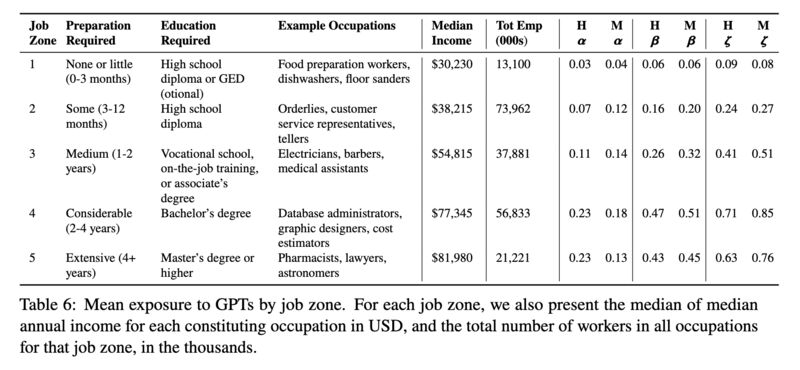
- Jobs are binned into zones based on education required. Zone 4 (bachelor) is most exposed (screenshot 5).
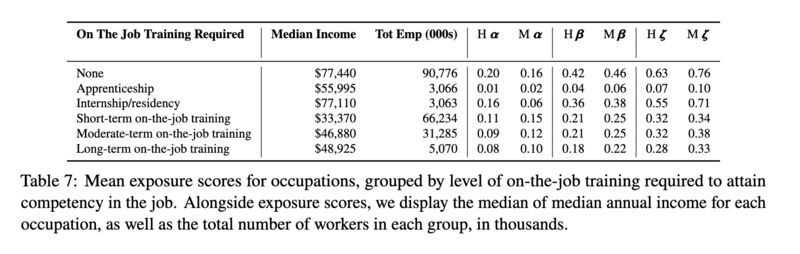
- Jobs are binned based on level of on-the-job training required. Interns/residents are most exposed (screenshot 6).
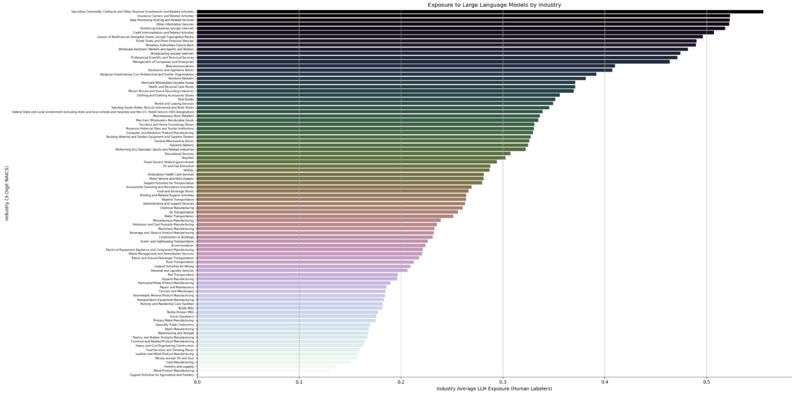
- Industry exposure to LLMs, the top 3: securities commodity contracts and financial investments, insurance carriers, data processing hosting (screenshot 7).
Tyna Eloundou, Sam Manning, Pamela Mishkin, and Daniel Rock. 2023. GPTs are GPTs: An Early Look at the Labor Market Impact Potential of Large Language Models. arXiv [econ.GN]. [1]
Abstract:
We investigate the potential implications of Generative Pre-trained Transformer (GPT) models and related technologies on the U.S. labor market. Using a new rubric, we assess occupations based on their correspondence with GPT capabilities, incorporating both human expertise and classifications from GPT-4. Our findings indicate that approximately 80% of the U.S. workforce could have at least 10% of their work tasks affected by the introduction of GPTs, while around 19% of workers may see at least 50% of their tasks impacted. The influence spans all wage levels, with higher-income jobs potentially facing greater exposure. Notably, the impact is not limited to industries with higher recent productivity growth. We conclude that Generative Pre-trained Transformers exhibit characteristics of general-purpose technologies (GPTs), suggesting that as these models could have notable economic, social, and policy implications.
Originally posted on LinkedIn.
References
[1] Tyna Eloundou, Sam Manning, Pamela Mishkin, and Daniel Rock. 2023. “GPTs are GPTs: An Early Look at the Labor Market Impact Potential of Large Language Models.” arXiv [econ.GN]. http://arxiv.org/abs/2303.10130