A Multitask, Multilingual, Multimodal Evaluation of ChatGPT
A comprehensive – multitask, multilingual, multimodal – evaluation of ChatGPT:
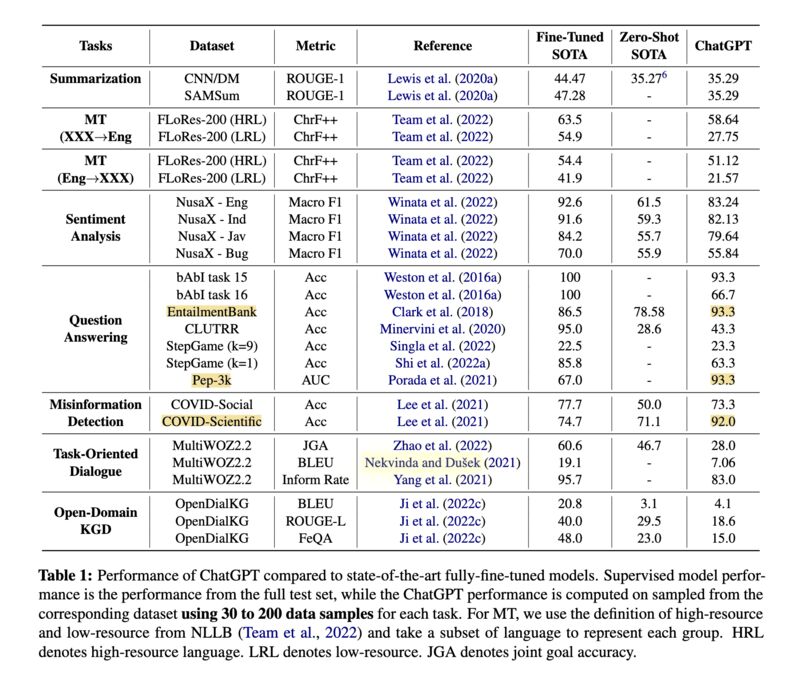
Compared to many SOTA LLMs, ChatGPT outperforms almost all on zero-shot tests (except for Open-domain KGD), and a few (3) finetuned ones (screenshot 1).
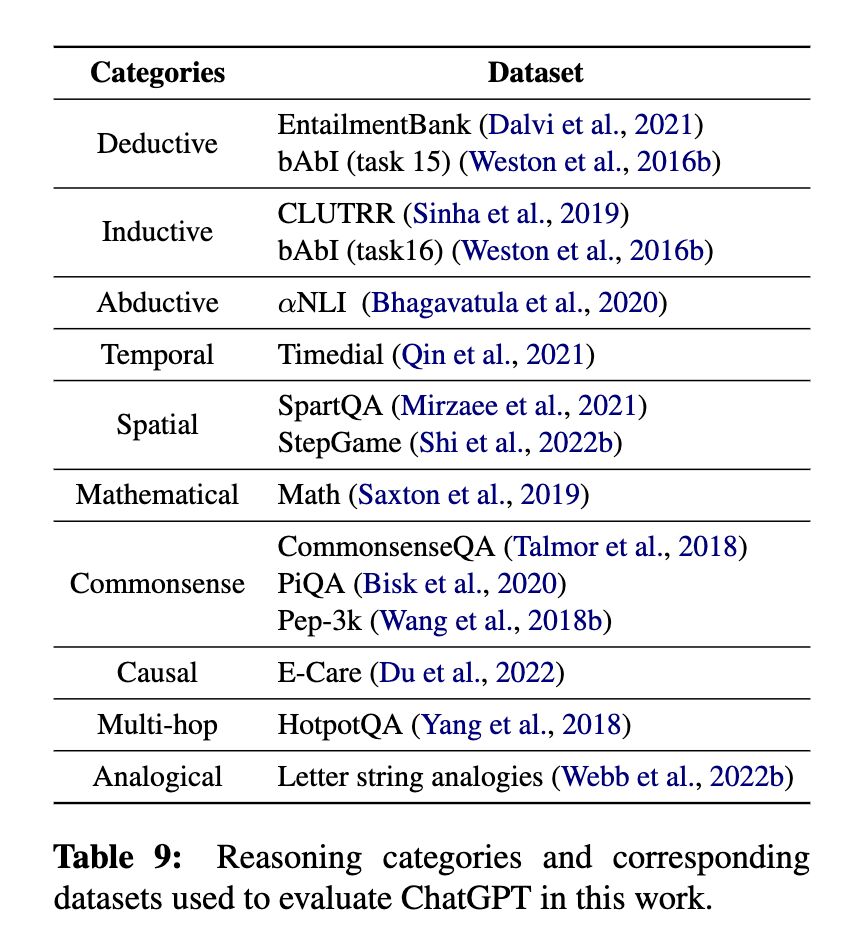
Focusing on Reasoning, evals are broken into logical (deduction, induction and abduction), temporal, spatial, mathematical, commonsense, etc (screenshot 2).
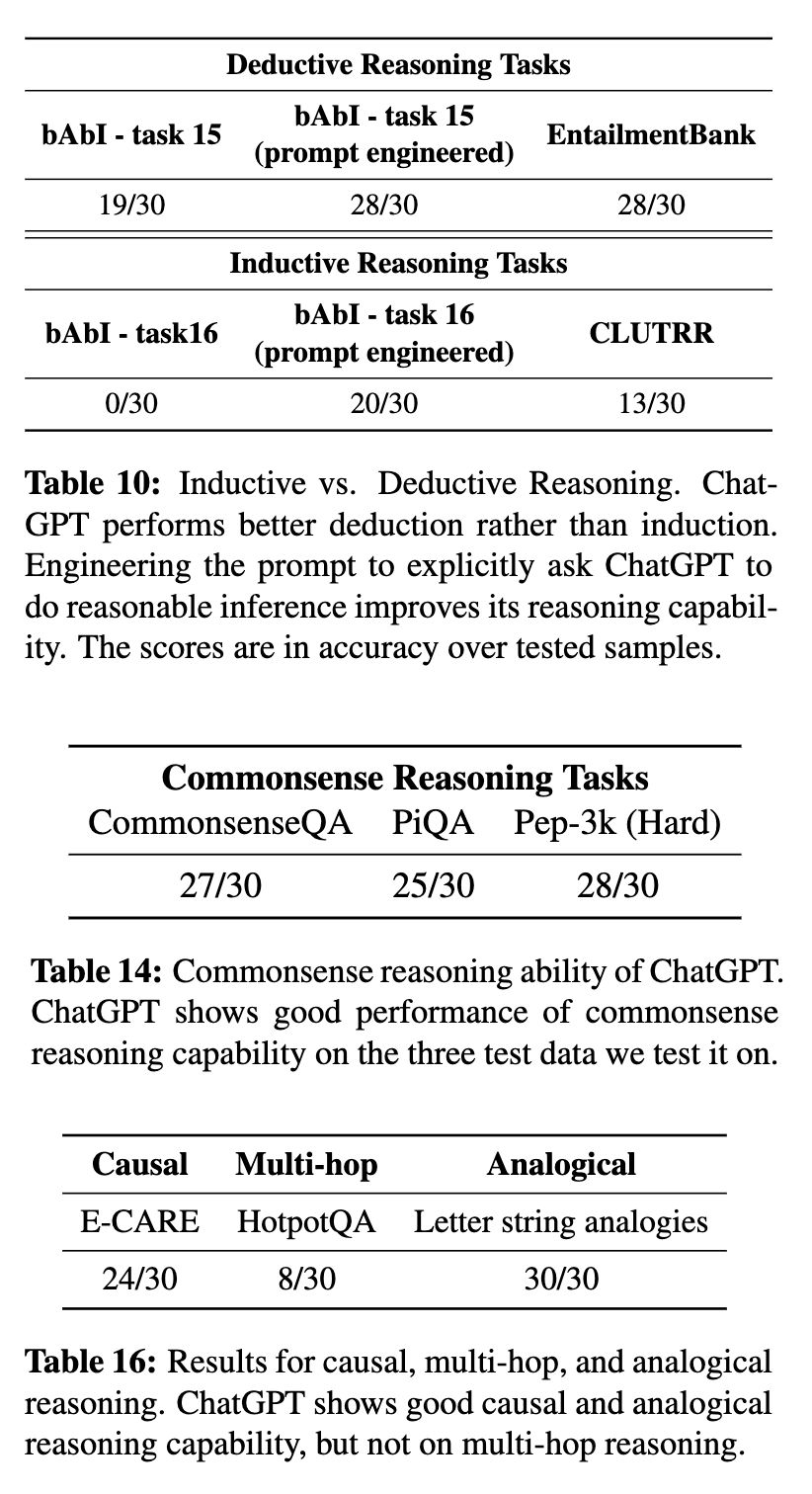
- On average it achieves 64.33% accuracy on reasoning hence is not a reliable reasoner. It performs worse on induction compared to deduction/abduction. But it’s good at commonsense, causal and analogical reasoning (screenshot 3).
CAVEAT that I didn’t see addressed in the paper (or maybe impossible to address): the possibility that some of these test sets are included in the training set.
Yejin Bang, Samuel Cahyawijaya, Nayeon L., Wenliang Dai, Dan Su, Bryan Wilie, Holy Lovenia, Ziwei Ji, Tiezheng YU, Willy Chung, Van Quyet DO, Yan XU, and Pascale Fung. 2023. A Multitask, Multilingual, Multimodal Evaluation of ChatGPT on Reasoning, Hallucination, and Interactivity. arXiv [cs.CL]. [1]
Abstract: This paper proposes a framework for quantitatively evaluating interactive LLMs such as ChatGPT using publicly available data sets. We carry out an extensive technical evaluation of ChatGPT using 21 data sets covering 8 different common NLP application tasks. We evaluate the multitask, multilingual and multi-modal aspects of ChatGPT based on these data sets and a newly designed multimodal dataset. We find that ChatGPT outperforms LLMs with zero-shot learning on most tasks and even outperforms fine-tuned models on some tasks. We find that it is better at understanding non-Latin script languages than generating them. It is able to generate multimodal content from textual prompts, via an intermediate code generation step. Moreover, we find that ChatGPT is 64.33% accurate on average in 10 different reasoning categories under logical reasoning, non-textual reasoning, and commonsense reasoning, hence making it an unreliable reasoner. It is, for example, better at deductive than inductive reasoning. ChatGPT suffers from hallucination problems like other LLMs and it generates more extrinsic hallucinations from its parametric memory as it does not have access to an external knowledge base. Finally, the interactive feature of ChatGPT enables human collaboration with the underlying LLM to improve its performance, i.e, 8% ROUGE-1 on summarization and 2% ChrF++ on machine translation, in a multi-turn “prompt engineering” fashion.
Originally posted on LinkedIn.
References
[1] Yejin Bang, Samuel Cahyawijaya, Nayeon L., Wenliang Dai, Dan Su, Bryan Wilie, Holy Lovenia, Ziwei Ji, Tiezheng YU, Willy Chung, Van Quyet DO, Yan XU, and Pascale Fung. 2023. “A Multitask, Multilingual, Multimodal Evaluation of ChatGPT on Reasoning, Hallucination, and Interactivity.” arXiv [cs.CL]. https://arxiv.org/abs/2302.04023