A Decade of Knowledge Graphs in NLP: A Survey
Summarizing in figures this excellent systematic survey of 507 papers on the state of knowledge graphs in NLP since the first Internet-age KG was announced 10 years ago, in the order of appearance:
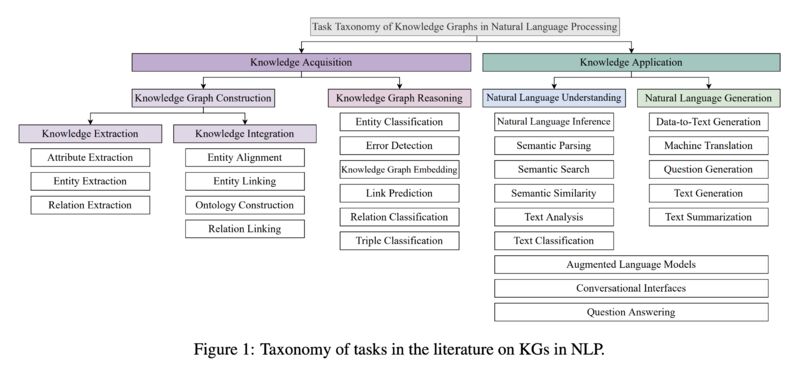
Tasks surveyed are broadly divided into Knowledge Acquistion and Knowledge Application.
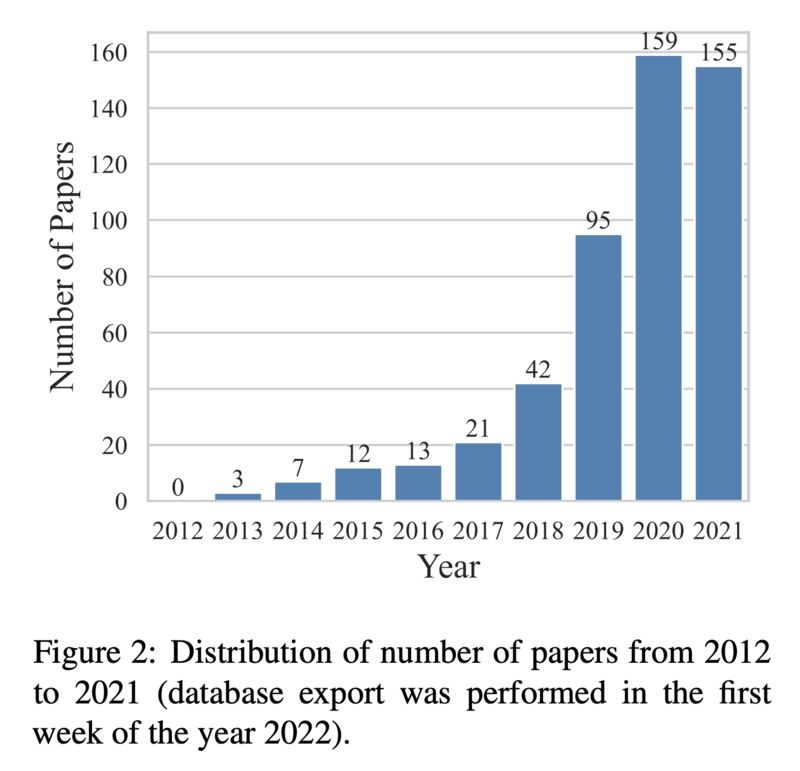
of papers exploded since 2018; # in 2021 was inconclusive as the cutoff day was the first week of 2022.
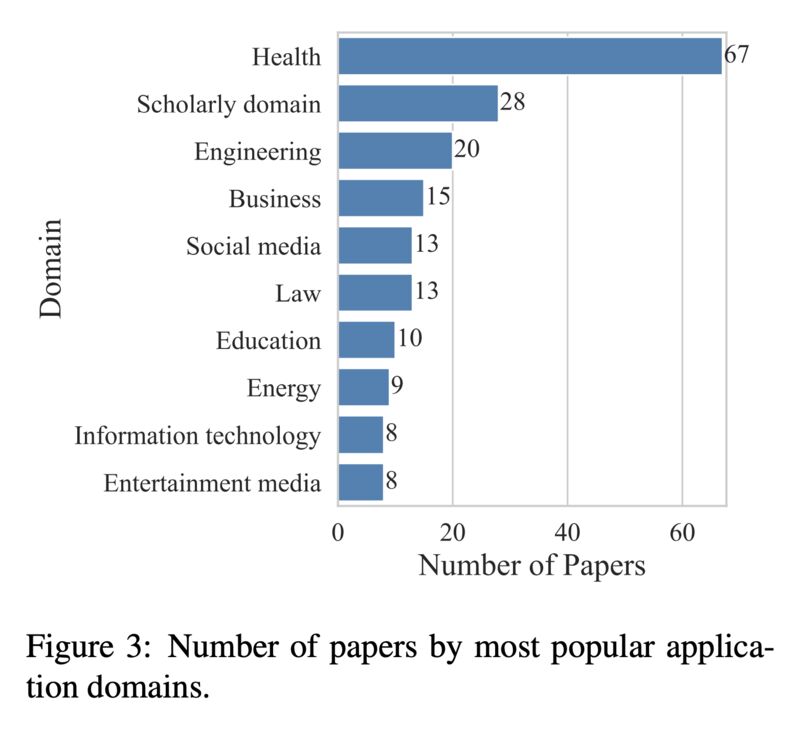
Most popular domain of KG application is health, bigger than the next three combined (scholarly, engineering, and business).
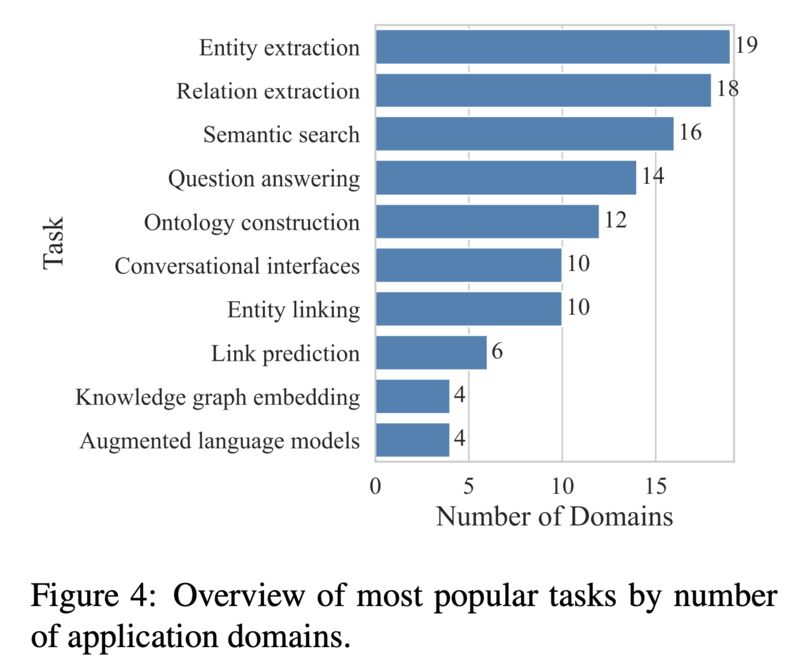
Entity and relation extraction are the two most widely applied tasks in terms of # of domains, as they are the most mature.
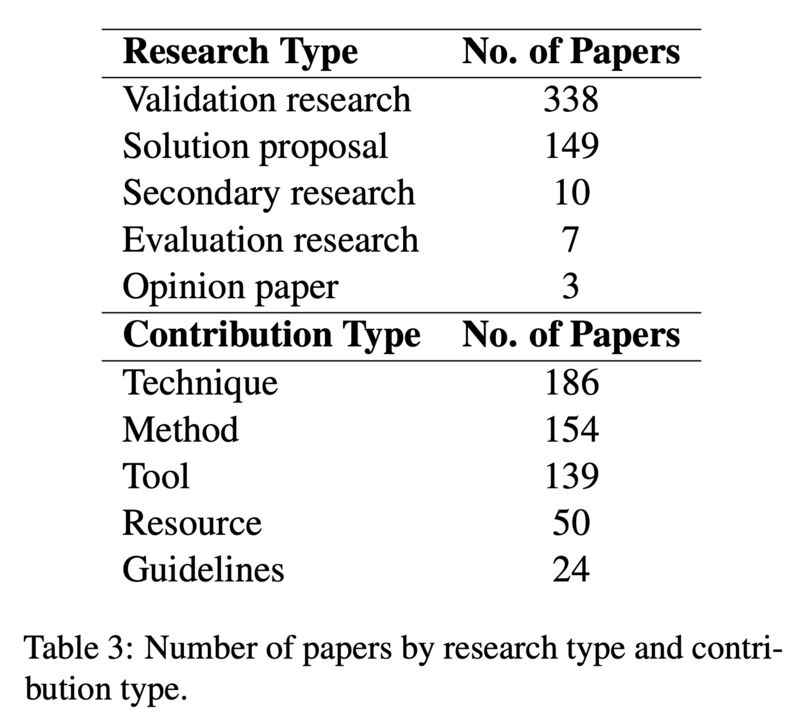
In terms of research types, the majority of the papers were devoted to validation research, implying the field is still young. Very few papers conducted secondary research (like this one), performed evaluations, or voiced opinions. This may indicate the difficulty of comparing different studies. In terms of contribution types, few papers discussed about resources and guidelines, which may explain why it’s difficult to compare different studies, because of their scarcity.
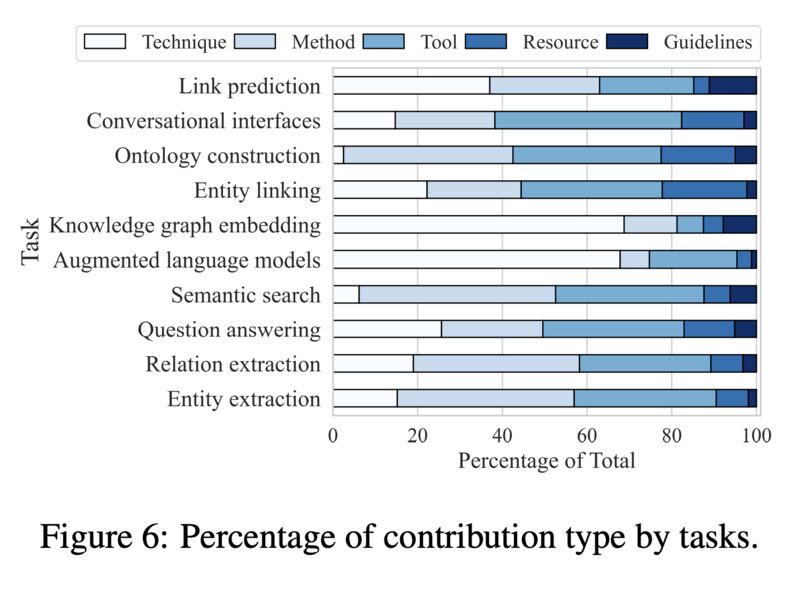
Knowledge graph embedding and augmented language models are the two tasks that saw the most “technique” papers, implying they are relatively young inquiries.
Phillip Schneider, Tim Schopf, Juraj Vladika, Michael Galkin, Elena Simperl, and Florian Matthes. 2022. “A Decade of Knowledge Graphs in Natural Language Processing: A Survey.” arXiv [cs.CL]. arXiv. [1].
Abstract:
In pace with developments in the research field of artificial intelligence, knowledge graphs (KGs) have attracted a surge of interest from both academia and industry. As a representation of semantic relations between entities, KGs have proven to be particularly relevant for natural language processing (NLP), experiencing a rapid spread and wide adoption within recent years. Given the increasing amount of research work in this area, several KG-related approaches have been surveyed in the NLP research community. However, a comprehensive study that categorizes established topics and reviews the maturity of individual research streams remains absent to this day. Contributing to closing this gap, we systematically analyzed 507 papers from the literature on KGs in NLP. Our survey encompasses a multifaceted review of tasks, research types, and contributions. As a result, we present a structured overview of the research landscape, provide a taxonomy of tasks, summarize our findings, and highlight directions for future work.
Originally posted on LinkedIn.
References
[1] Phillip Schneider, Tim Schopf, Juraj Vladika, Michael Galkin, Elena Simperl, and Florian Matthes. “A Decade of Knowledge Graphs in Natural Language Processing: A Survey.” arXiv, 2022. http://arxiv.org/abs/2210.00105